Technical Comparison, Market Applications & Delivery Technologies
Each grade has its own full market applications guide.
Retinol (Vitamin A) is widely regarded as the gold-standard anti-aging and cell-communicating ingredient in dermatology. While finished consumer products typically contain pure retinol concentrations ranging from 0.1% to 1.0%, raw material manufacturers and industrial formulators utilize high-potency concentrates — specifically Retinol 10% and Retinol 15% — standardized in fluid carriers such as Caprylic/Capric Triglyceride, Polysorbate-20, or encapsulated lipid systems. Working with high-concentration raw materials allows formulators to overcome severe stability challenges (rapid oxidation in air, light-sensitivity, heat degradation) while maintaining ease of handling and dosing during large-scale manufacturing.
Raw, unencapsulated retinol degrades rapidly when exposed to oxygen, trace metals, or ambient temperature. Advanced microencapsulation — using liposomal or polymeric carrier systems — protects the active retinol core within a protective lipid/polymer membrane, enabling slow, controlled dermal translocation.
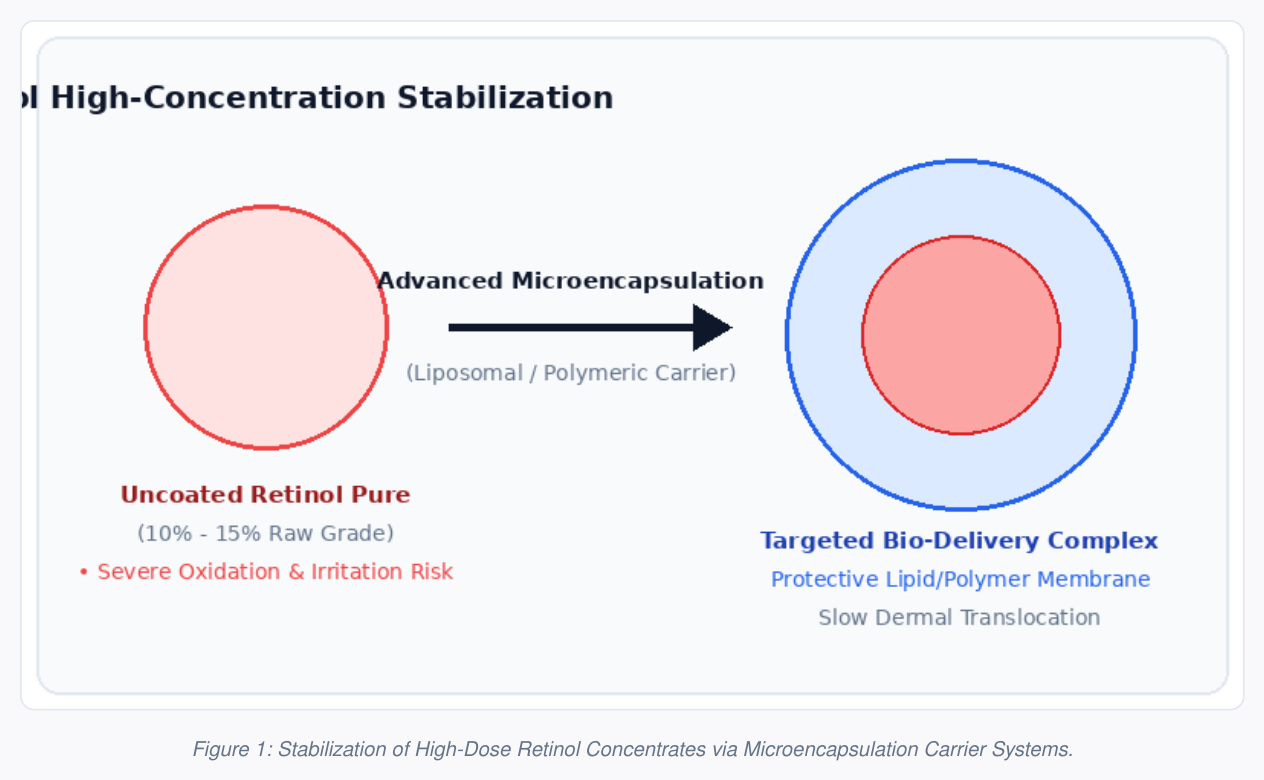
Active base for professional-use booster serums, clinical anti-wrinkle concentrates, and post-peel maintenance systems targeting deep rhytids and photo-damage.
Diluted from 10% or 15% concentrate down to finished-goods levels (0.3%–1.0% pure retinol) to power night repair creams, eye serums, and resurfacing treatments.
Accelerates epidermal cell turnover, unclogging pores and clearing post-inflammatory hyperpigmentation in spot treatments and targeted facial oils.
High-yield concentrates make body-scale manufacturing cost-effective for anti-aging body creams, firming neck creams, and rough & bumpy skin treatments.
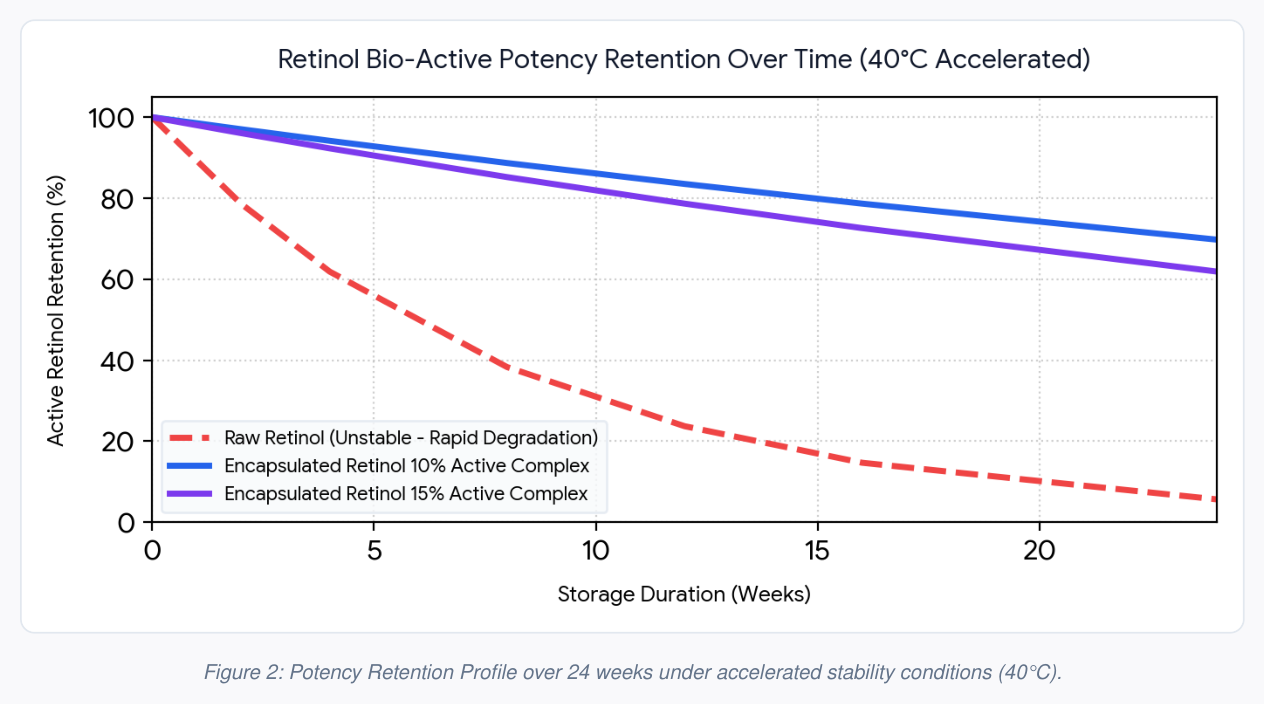
Under accelerated stability conditions (40°C over 24 weeks), raw unencapsulated retinol shows rapid degradation, retaining well under 20% of active potency by week 24. Encapsulated Retinol 10% and 15% active complexes retain substantially higher potency across the same period, protected by their liposomal or polymeric carrier membrane — translating directly into longer shelf-life and more consistent dosage across the product lifecycle.
| Technical Parameter | Retinol 10% Concentrate | Retinol 15% Concentrate |
|---|---|---|
| Primary Physical State | Liquid Fluid / Liposomal Dispersion | Viscous Oil / Anhydrous Fluid Concentrate |
| Recommended Finished Dosage | 1.0% to 10.0% input (yields 0.1%–1.0% retinol) | 0.67% to 6.6% input (yields 0.1%–1.0% retinol) |
| Target Formulations | Water-phase serums & gel creams | Anhydrous oils, elixirs & heavy creams |
| Manufacturing Process | Cold process / addition at <40°C | Cold process / oil phase blend at <45°C |
| Oxidation Sensitivity | Moderate (protected in dispersion) | High (requires inert nitrogen blanket) |
| Irritation Potential | Low (sustained translocation) | Moderate to low (controlled) |
In many global jurisdictions, including under EU SCCS guidelines, maximum concentration limits for leave-on face products are capped at 0.3% pure retinol equivalent. Retinol 10% and 15% concentrates must be properly diluted in finished consumer products to comply with regional safety frameworks. Formulators should confirm applicable limits for their target market prior to launch.
Request tech specs, stability data, or a customised sample kit for your target product formulation.
Request a Sample